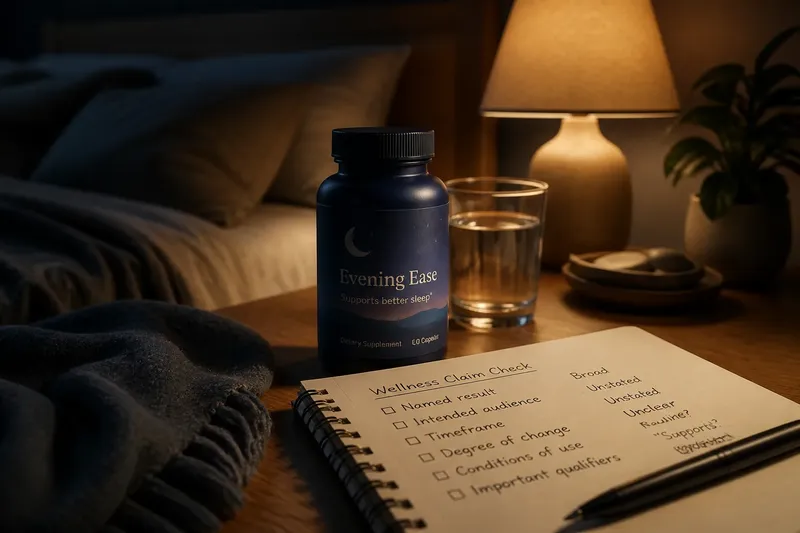
A Calm Way to Read a Wellness Article
A calm way to read a wellness article helps you spot persuasive wording, separate a personal story from an explanation, and know when to ask for help.

You open a wellness article while the kettle warms, and its confident headline makes a new routine sound right for you. A calm way to read a wellness article starts with a small question: what is this piece asking you to believe or do, and what does it actually explain?
You do not need to verify every sentence. Read for the article’s framing, its persuasive language, and any boundary that matters before you act.
What is the article asking you to believe or do?
Look for the article’s central proposal, rather than making a note that repeats the headline. Does it ask you to try a practice, buy a product, avoid something, or reconsider an idea? Name the request in plain language.
Then notice how the piece supports that request. It might offer an explanation, describe a personal experience, or lean on a vivid phrase. These are different kinds of material: a story can make a topic feel relevant without explaining why an effect occurred or whether it applies to someone else.
Say you find an article recommending a short walk after lunch and describing it as a way to “reset your energy.” Imagine the article explains that a change of scene may feel refreshing, but offers no clear meaning for “reset.” You can distinguish its concrete suggestion from its broad phrase without deciding whether the walk is right for you.
How can I spot persuasion without treating it as proof?
Notice words that create urgency or social pressure: “secret,” “must,” “finally,” or “everyone,” for example. Their presence does not make the claim false. It does tell you to separate the push to act from the reasons the article gives.
Personal stories need the same distinction. A writer may describe feeling better after changing a routine. That account can explain why the subject matters to them, but it does not establish what caused the change or what another reader should expect.
If a passage feels urgent, reread the sentence that says what action is being promoted. Ask whether the explanation gives you a reason to consider it, or mainly gives you a reason to feel behind.
When should I pause before acting on a wellness article?
Pause when the article uses broad phrases without explaining them, leaves an important limit unstated, or connects advice to a personal health decision. The useful move is not to fill in missing details with a reassuring guess. Treat them as unknown.
- If a phrase is vague, such as “balances hormones,” ask what it means in practical terms; if the article does not say, treat the phrase as unexplained rather than as a specific outcome.
- If the advice sounds universal, check whether the article says who it is intended for; if it names no boundaries, do not assume it applies to every reader.
- If a personal story supports the advice, notice that it describes one person’s experience; if the article offers no other explanation, keep the story as context rather than proof.
- If the article promotes a product or service, note that alongside the advice; if the relationship is unclear, do not treat the promotion as independent support.
- If possible downsides or alternatives are absent, mark that omission; if the choice has personal health consequences, seek more context before acting.
- If the decision concerns symptoms, treatment, or a health condition, keep the article separate from personal guidance; if you need to decide what to do, ask a qualified health professional about your circumstances.
These checks are not a verdict on the writer. They help you see where the article’s explanation ends and where a personal decision begins.
What questions do readers ask before acting?
Should I read the whole article before judging its claim?
Read enough to understand what action it recommends and what reasons it gives. If a key limit remains unclear, note that gap rather than treating a confident tone as an answer.
What if the headline sounds stronger than the article?
Pay attention to the body’s more specific wording and note the mismatch. A vivid headline may make a broader promise than the text itself supports.
Can a personal story tell me whether advice will work for me?
A story tells you what one person says happened, not what another reader should expect. Look for a separate explanation, and keep personal relevance as an open question.
When should I ask a health professional?
Ask a qualified professional if the article raises a decision about symptoms, treatment, a health condition, or a product that could affect your care. Bring the specific advice and explain the circumstances that matter to you.
How can I keep the pause brief?
Imagine you are reading an invented article about evening journaling. It recommends writing down worries before bed and says this can help with sleep, but it does not explain who the suggestion is meant for. You note the action—writing before bed—and mark the intended audience as unclear. If you are simply curious about the idea, you can leave it there; if you are considering a change because of ongoing sleep difficulties, you can ask a qualified health professional instead of treating the article as personal guidance.
A calm way to read a wellness article is not a verdict on every claim. It is a pause long enough to notice what the piece asks, how it tries to persuade you, and whether a personal decision needs a better-informed conversation.