What a Wellness Claim Actually Promises
Learn to assess a wellness claim by identifying its stated result, intended audience, timeframe, and limits before deciding what further information matters.
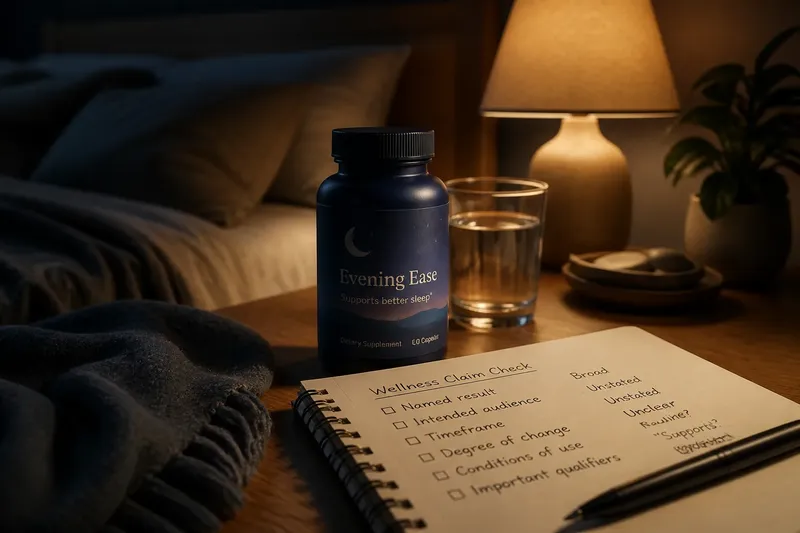
“Supports better sleep” is a common kind of wellness claim: reassuring, but open to several meanings. To understand what a wellness claim actually promises, look at its wording, the product context, and the limits the language leaves visible.
What should you check first?
Begin with the exact sentence on the label, advertisement, or product page. Keep its qualifiers—words such as “may,” “supports,” or “for occasional use”—rather than rewriting it into a stronger promise.
Then make a compact claim record. For each item, note what the wording says and choose the next action based on what you observe:
- Named result: If the claim identifies an observable change, write it in plain language; if it uses only a broad term such as “better,” keep that term marked as undefined and look for a specific explanation.
- Intended audience: If the wording names a group or starting condition, record it; if not, mark the audience as unspecified rather than assuming the claim applies to everyone.
- Timeframe: If the claim states when a change is expected, preserve that period; if it does not, record “not stated” and do not supply your own timeline.
- Degree of change: If the wording describes how much or how often a change should occur, note that detail; if it does not, treat the expected size of the result as unresolved.
- Conditions of use: If the claim ties the result to a routine or other condition, record that condition; if none appears, do not assume one.
- Important qualifiers: If words such as “may” or “supports” limit the assertion, retain them; if the sentence elsewhere makes a stronger promise, read the full wording together and note the difference.
This record is not a rating of the product. It is a way to avoid adding promises the wording does not make.
How do you separate a broad benefit from a specific result?
Words like “better,” “balanced,” and “refreshed” can point toward a benefit without naming what a person would notice. “Better sleep,” for instance, might refer to falling asleep, waking during the night, or feeling rested in the morning. Those are distinct outcomes, not interchangeable versions of one result.
Look for language that makes the outcome observable. “Helps you fall asleep more comfortably” is narrower than “supports better sleep,” though “comfortably” may still need explanation. If several interpretations remain plausible, keep them separate instead of choosing the most appealing one.
Verbs also matter, but they do not settle the meaning by themselves. “Supports” may sound less direct than “will improve,” yet neither word tells you exactly what change is intended unless the rest of the claim does.
What does the claim leave open?
Say you are considering an invented product called Evening Ease. Its package says, “Supports better sleep.” You record the result as broad, the audience as unstated, the timeframe as unstated, and the expected degree of change as unclear. Your next decision is to look for a more specific explanation; if none appears, leave those points unresolved rather than treating them as implied.
Now imagine the same invented package adds, “For adults who have occasional trouble settling at bedtime; supports falling asleep more comfortably as part of an evening routine.” The audience and general outcome are clearer, and the routine is named. The timeframe, expected degree of change, and meaning of “more comfortably” remain unresolved. The more detailed sentence narrows the promise, but it does not answer every question.
This is the practical distinction: a claim can be specific in one respect and vague in another. Record each part separately, then decide what the wording supports you in asking next.
How can you tell whether supporting information addresses the claim?
When a label or product page offers an explanation, check whether it addresses the same kind of result and the same audience described by the claim. A general discussion of relaxation, for example, would not by itself clarify a specific promise about falling asleep more comfortably. If the explanation concerns a different result or group, note the mismatch; if it leaves a key term undefined, look for a clearer description rather than filling in the gap.
Timeframe and conditions matter here, too. If the claim specifies a routine or period, information that does not address that condition may leave the claim’s practical meaning unclear. If no timeframe appears in the claim, supporting material cannot make the original wording more precise unless it clearly explains how it applies.
What questions should you ask about a wellness claim?
What change does the claim name?
Identify the result in ordinary language, such as falling asleep more comfortably or feeling more rested. If the wording offers only a broad benefit, keep the outcome marked as unclear.
Who does the claim appear to concern?
Record any stated group and starting condition. If neither is named, treat the audience as unspecified rather than extending the claim to everyone.
When is the result supposed to happen?
Look for an explicit period or a clear condition tied to use. If the claim gives neither, record the timeframe as unstated.
What should you do with unanswered details?
Keep each gap separate from what the claim does say. If a specific detail matters to your decision and the wording does not provide it, seek a clearer explanation or treat the promise as unresolved.
When should a health professional be involved?
Reading a product claim can clarify its wording, but it cannot determine whether a product or practice is suitable for your health. If you have an ongoing sleep concern, a medical condition, or questions about combining a product with medication, ask a qualified health professional. Do not use vague marketing language as a substitute for individual advice.
For the invented Evening Ease package, the careful reading remains limited: the label names a possible sleep-related benefit, but leaves important details open. The search phrase “what a wellness claim actually promises” is most useful as a reminder to preserve that boundary—record what is stated, mark what is missing, and let unresolved wording remain unresolved.